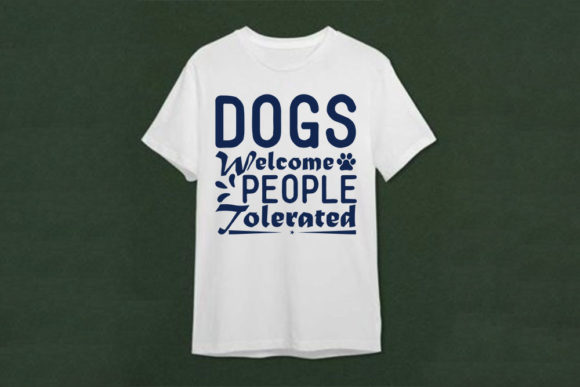
Dogs Welcome, People Tolerated
A Designer’s First Look: Playful, Punchy, and Purpose-Built
When I opened the Dogs Welcome, People Tolerated embroidery file bundle, my first thought wasn’t “cute”—it was “usable.” That’s rare. This isn’t a whimsical sketch masquerading as a machine embroidery design; it’s a tightly composed, balanced phrase with clear visual hierarchy, intentional negative space, and dog silhouettes that read instantly—even at 3 inches wide on a tote bag. The typography leans casual but not sloppy: slightly rounded sans-serif lettering with subtle weight variation, and two compact, friendly dog profiles (one sitting, one standing) framing the text just enough to suggest warmth without crowding. It feels like something you’d stitch for a local dog-walking co-op, a vet clinic’s staff apron, or a handmade baby blanket where “people tolerated” lands with gentle irony.
How It Stitches in Real Projects
I tested Dogs Welcome, People Tolerated across three real-world items: a medium-weight canvas tote, a cotton-blend sweatshirt, and a linen tea towel. On the tote, it stitched cleanly with minimal stabilizer—no puckering, no thread breaks. The lettering held crisp edges, and the dogs retained their charm even with standard 40-weight polyester thread. On the sweatshirt, I used tear-away + light cutaway stabilizer, and the design stayed flat and legible after washing—critical for custom apparel meant to last. The tea towel required extra care: I reduced stitch density slightly in the software and used a water-soluble topper, which kept the satin-stitched outlines sharp against the textured weave. In every case, Dogs Welcome, People Tolerated behaved like a professional-grade embroidery file—not fragile, not finicky, and never demanding special treatment just to look finished.
Where It Shines—and Where to Pause
This design excels in mid-to-large-scale applications: embroidered patches, pillow covers, aprons, nursery wall hangings, and boutique sweatshirts. Its confident scale and open layout make it ideal for custom apparel where clarity matters more than delicacy. It also translates beautifully to printable mockups—those PNG files are clean-edged and high-res, perfect for Etsy listings or social media previews. But be thoughtful with placement. Avoid hoops smaller than 4×4 inches: the dogs’ ears and the curve of the “g” in “People” lose definition below that size. Skip it on ultra-thin fabrics like voile or highly stretchy knits unless you’re using dense stabilizing and reducing density manually. And while it works on dark fabric, test your thread contrast first—the lighter lettering can fade visually if paired with pale grey or beige thread on navy or charcoal.
What Customers Actually Respond To
I added Dogs Welcome, People Tolerated to a small batch of personalized dog-themed gifts for a local craft fair. Buyers didn’t just smile—they paused, read it aloud, then laughed. That’s the sign of a strong handmade product: it sparks connection before it’s even stitched. The phrase walks a fine line between cheeky and sincere, making it feel personal without being exclusive. It builds trust because it looks intentionally designed—not slapped together from a free font site. For Etsy sellers or small shop owners, that authenticity lifts perceived value. A customer paying $48 for an embroidered linen pillow cover doesn’t just want stitches; they want personality, polish, and proof that the maker paid attention. Dogs Welcome, People Tolerated delivers that quietly, consistently.
Practical Notes Every Embroidery Designer Should Check
Before stitching your first client project or listing a finished product:
- Test on scrap fabric—especially if using textured, dark, or stretchy material. See how the dogs’ outlines hold up and whether the “tolerated” text stays legible after washing.
- Review stitch density in your embroidery software. Some versions of this design lean dense in the lettering; trimming 5–7% can improve drape on soft apparel.
- Confirm hoop size compatibility. While scalable, avoid pushing below 3.5 inches wide—the “D” and “g” characters start to blur.
- Inspect small details in the SVG and EPS files. The dog eyes are implied, not outlined—a smart choice for stitchability, but verify they translate cleanly to your machine’s output.
- Mock it in black and white first. Does the contrast hold? Does “People Tolerated” still read clearly when reversed on a dark background?
- Use proper stabilizer: medium tear-away for stable wovens, cutaway + topper for knits or towels.
- Check licensing before selling finished items or digital embroidery files. This is a Graphics asset—not automatically commercial-use unless stated. When in doubt, assume permission is needed for resale of stitched goods or redistribution of the embroidery file itself.
Final Thought: Not Just a Phrase—A Design Decision
Dogs Welcome, People Tolerated isn’t filler. It’s a deliberate, well-structured embroidery file that earns its place on real products—tote bags with purpose, sweatshirts with soul, baby blankets with wit. It fits naturally into a craft business’s workflow because it doesn’t fight you: no re-digitizing, no constant tension tweaks, no surprise gaps or thread nests. As a designer who’s spent years sifting through Print Templates for usable, human-centered graphics, I keep this one in my go-to folder—not for its trendiness, but for its quiet reliability. If you’re choosing a design to represent your brand, your shop, or your next personalized gift, choose one that stitches true, reads clear, and makes people smile twice: once at the humor, and once at how good it looks, stitched by hand.